
Directional analysis of 2D images — ImageJ/Fiji plugins
August 2026

OrientationJ Benchmarking
Compares the distribution of orientation measured by seven tools on four images
(synthetic_rings_dither_512, synthetic_nematic_512, synthetic_noise_512,
collagen), all with the cubic-spline gradient and structure-tensor window σ = 1
wherever the tool exposes those choices. Two comparisons:
- masked — only pixels inside the structure masks; without Directionality (no mask support);
- full — every pixel; without the direct gradient (its unsmoothed histogram is dominated by the degenerate flat-background spikes).
Coinciding curves are told apart by line style — the Fiji plugin is a thick solid base line, the port rides on it dashed, OrientationPy dotted — and the y-limits hug the data to magnify the nearly flat histograms.
Results
Inside the structure mask
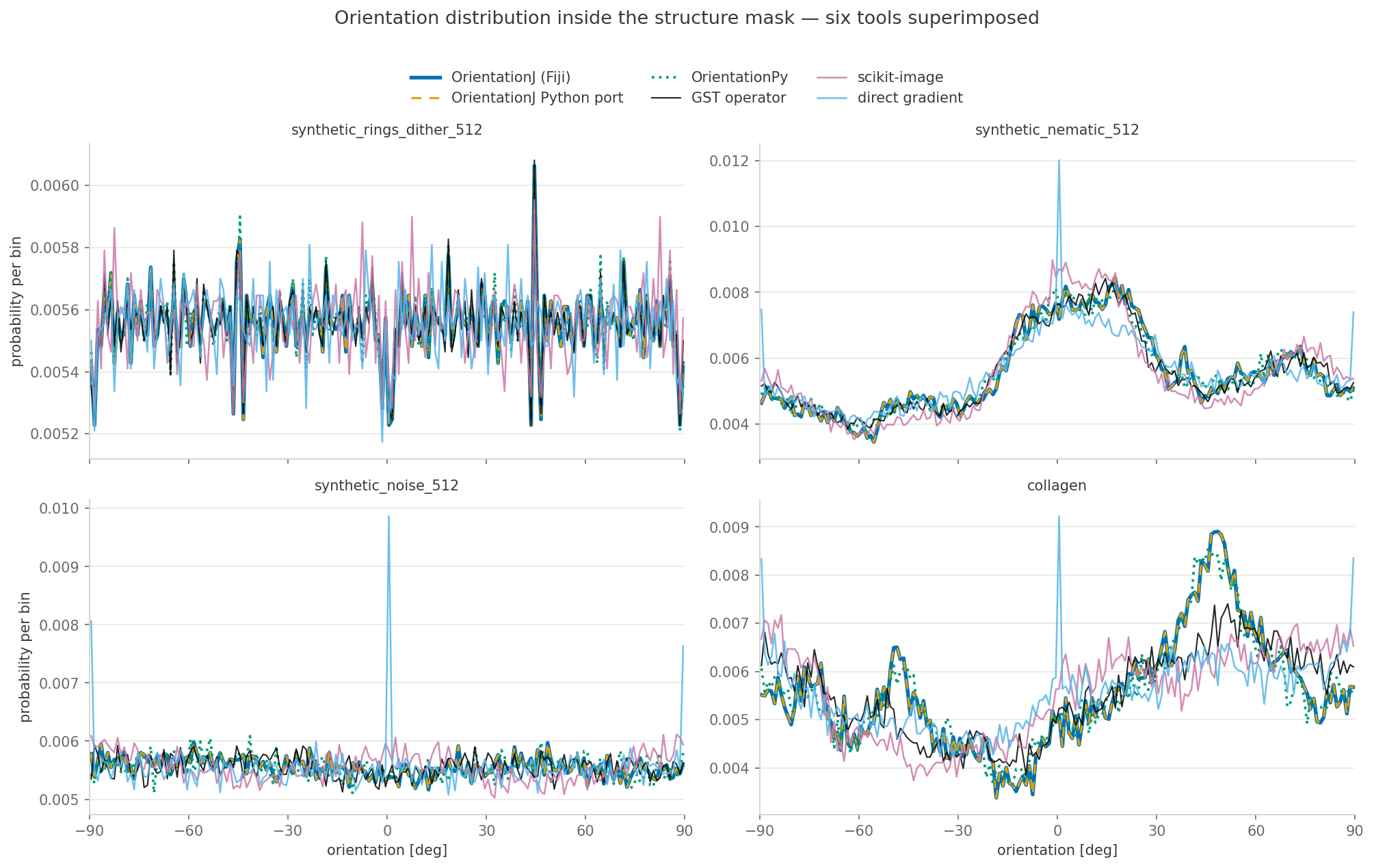
Over the whole image
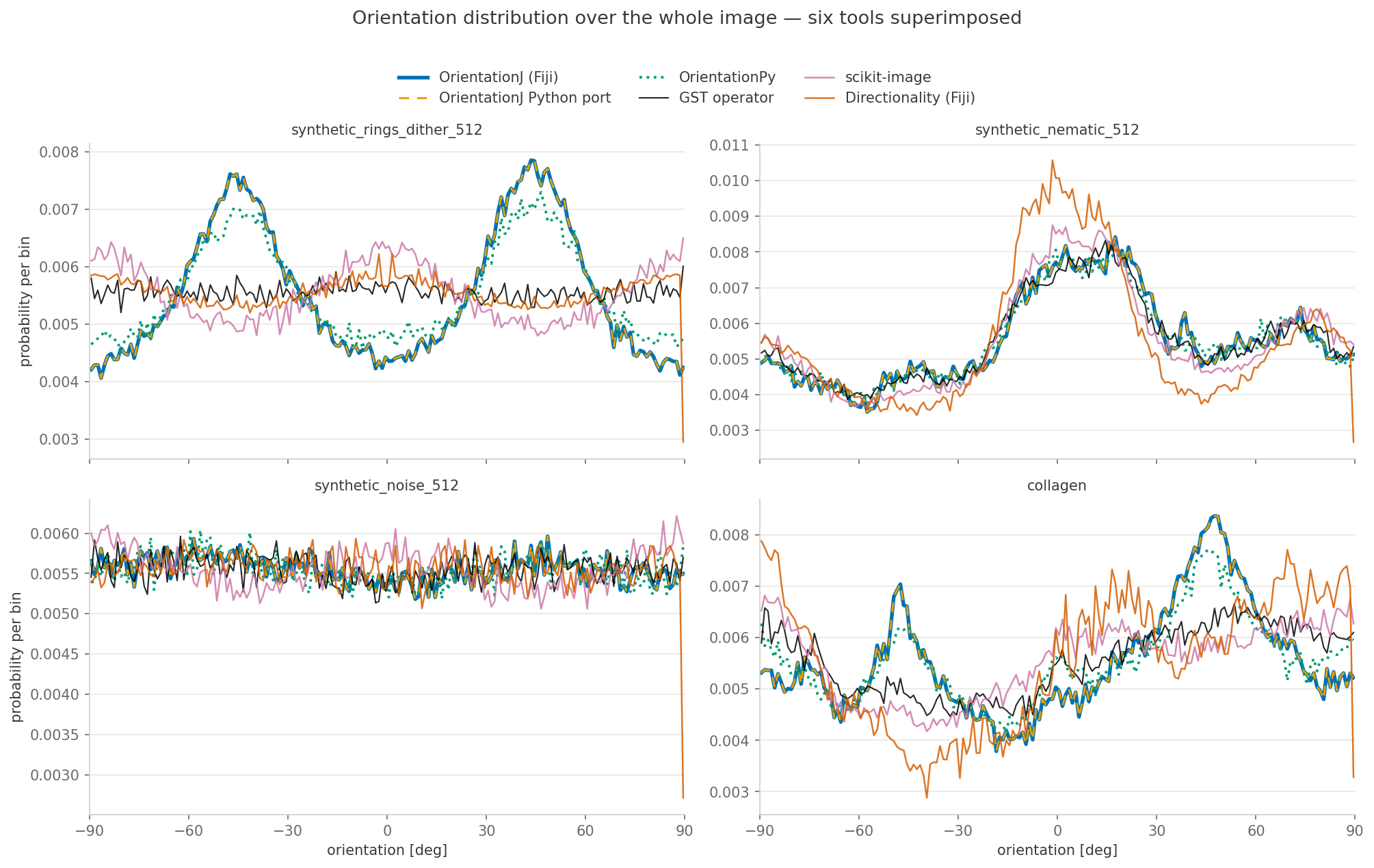
Inside the masks the Fiji plugin and its Python port agree exactly (RMSE 0 on all four images); over the whole image they differ by at most 0.4·10⁻³ probability per bin, from the float32 rounding of the saved degree maps at the bin boundaries. OrientationPy stays within 0.5·10⁻³ of the port and every other tool within 1.6·10⁻³ — differences traceable to their gradient flavor or their own histogram. Each figure shows six curves: the masked comparison drops Directionality, which has no mask support, and the full one drops the direct gradient, whose unsmoothed histogram is dominated by flat-background spikes.
The seven tools
- OrientationJ (Fiji) — the Java plugin; its saved orientation maps are binned here.
- OrientationJ Python port — the Python port, the faithful reimplementation.
- OrientationPy — spline gradient, σ = 1, fiber orientation.
- GST operator — gst_operator.py, the
forward()of the minimal Python version: Gaussian-derivative gradient and Gaussian window, analytic in Fourier. - scikit-image —
feature.structure_tensor(finite-difference gradient), same tensor formula. - direct gradient — per-pixel angle perpendicular to the spline gradient, no tensor smoothing (σ = 0).
- Directionality (Fiji) — Local-gradient method, its own histogram; no mask support, whole image.
All tools share the OrientationJ angle convention (verified on calibration sinusoids): degrees in [−90, +90], counter-clockwise from the horizontal of the displayed image. Histograms: 180 bins of 1°, normalized to probability per bin.
Files
| file | content |
|---|---|
| benchmark_orientation.ipynb | runs the five Python tools, loads the Fiji results, draws the comparison |
| macro-orientationj.ijm | Fiji macro — OrientationJ Analysis (spline, σ = 1), saves the orientation maps |
| macro-directionality.ijm | Fiji macro — Directionality plugin (GUI only: it saves the displayed table) |
| script-directionality.groovy | same as the macro through the plugin API, also works headless |
Other tools
OrientationPy — the Python successor of OrientationJ, 2D and 3D · Directionality (Fiji) · FiberFit · CT-FIRE · FiberO · questions: image.sc forum