Aggregation window
OrientationJ aggregates the gradient of many pixels before it reads an orientation: over the Gaussian window σ of the structure tensor in Analysis, and over the cell of the grid in Vector Field. This assessment runs the plugin (version 2.2.0, cubic-spline gradient) on four images of the test set and sweeps the two sizes:
- the structure-tensor window σ = 1, 2, 3, 4, 5, 6, 8, 10 px, with Analysis — the orientation map (degrees) and the color survey at each σ;
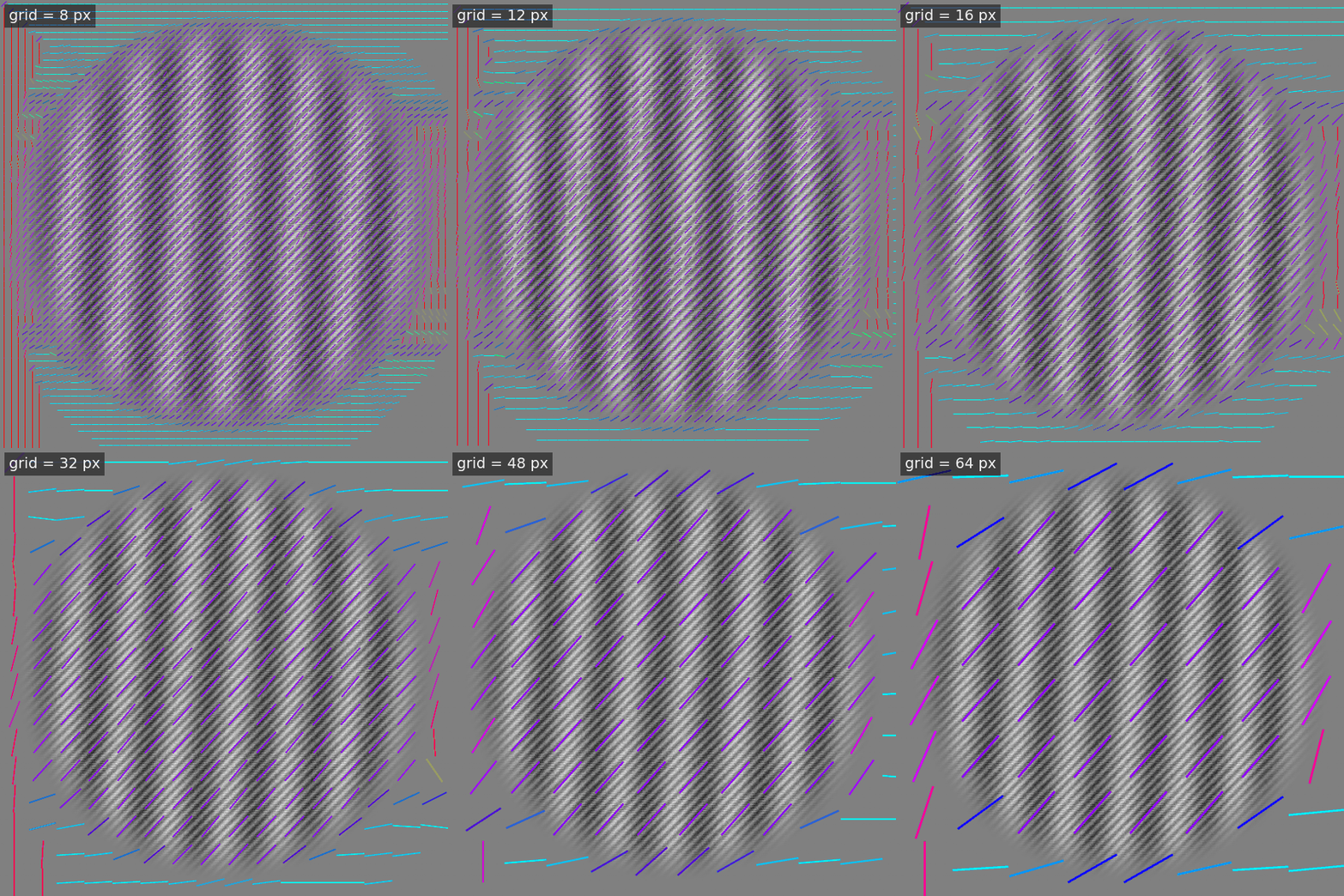
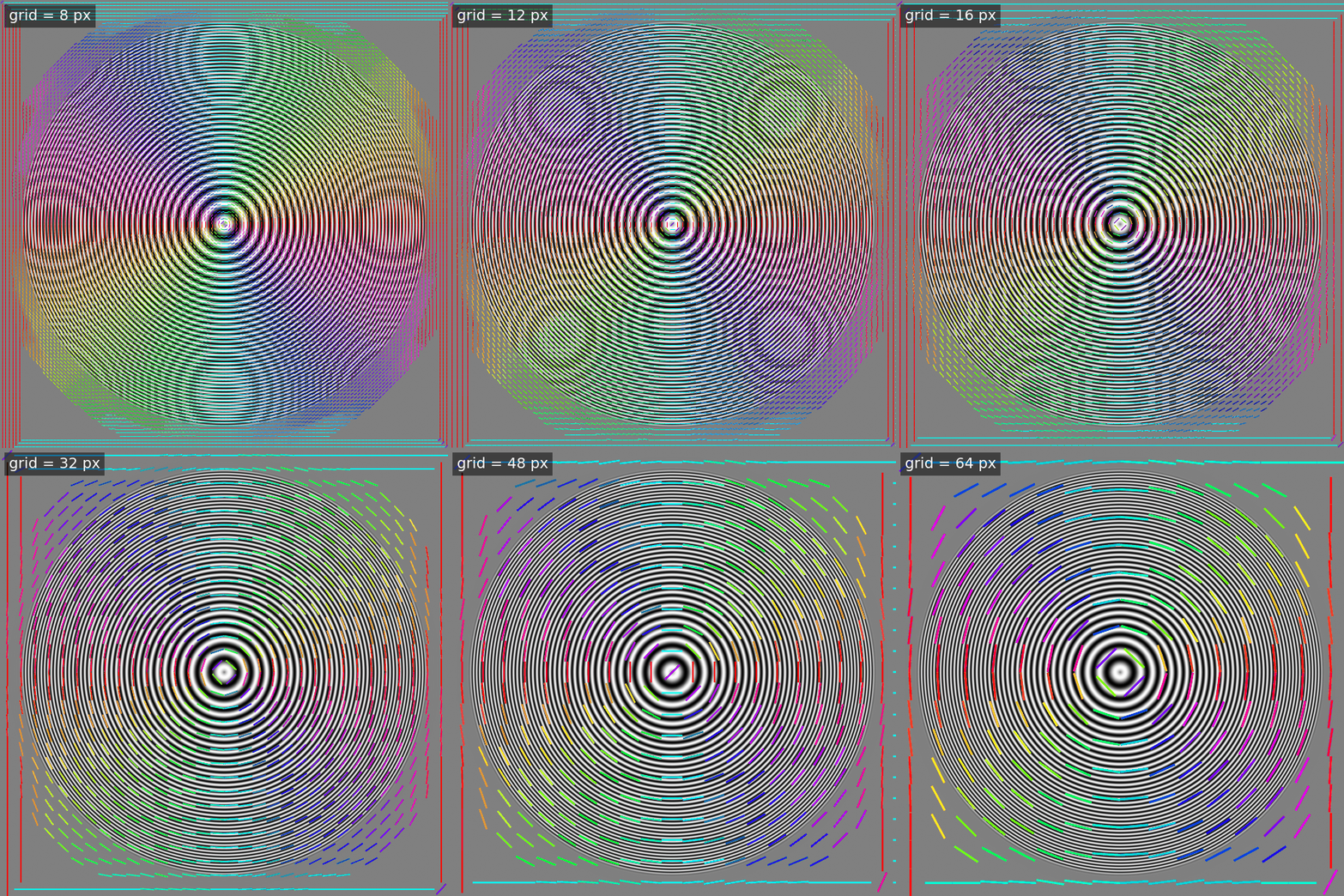
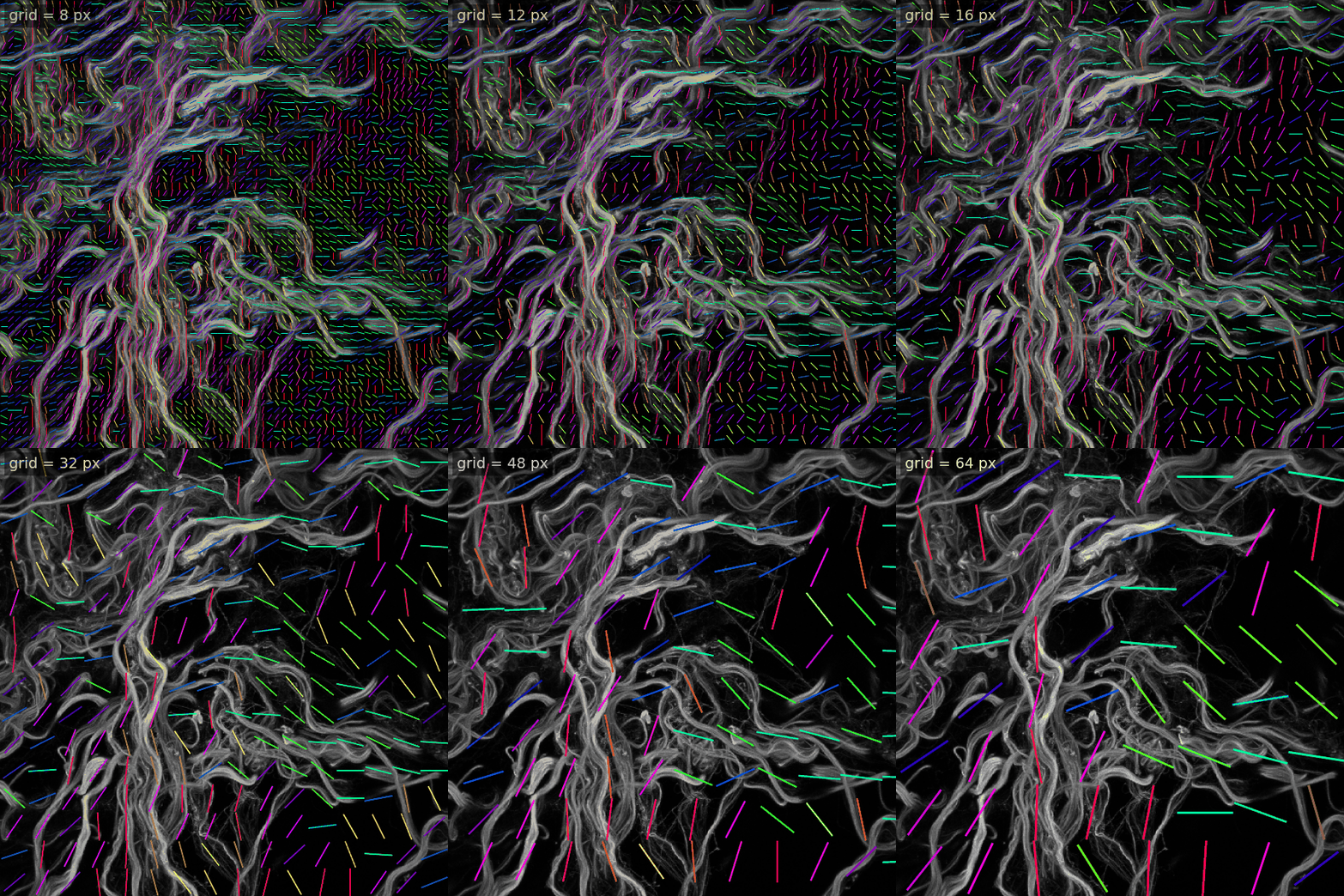
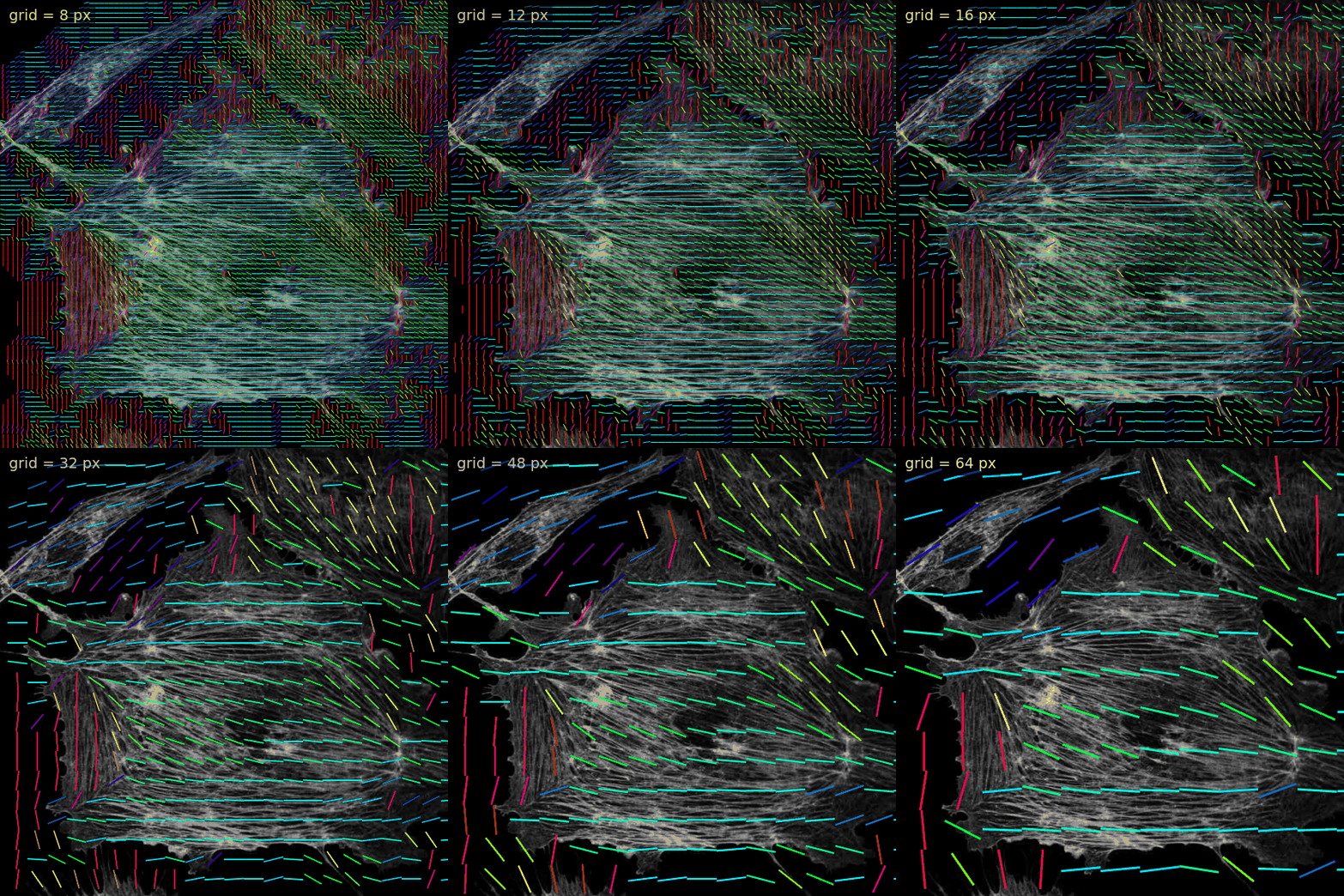
- the vector-field grid = 8, 12, 16, 24, 32, 48, 64 px, with Vector Field at σ = 1 and the nematic aggregation of the cell (the default since 2.2.0) — the OJ-Vector-Field table at each grid size.
The σ parameter itself is described on the Local window page, the grid and its aggregation on the plugins page.
The four images
| image | size | content |
|---|---|---|
synthetic_wave_512 |
512 × 512 | three superposed sinusoidal waves of periods 2, 8 and 64 px at 5°, 45° and 85°, plus uniform noise, in a round window |
synthetic_chirp_1024 |
1024 × 1024 | radial chirp, the frequency growing from the center to the border; the orientation is tangential everywhere |
collagen |
512 × 512 | collagen fibers (real) |
cell_aemisegger |
728 × 728 | fluorescence cell, actin fibers (real) |
The orientation distributions count the pixels inside the structure mask of each image only.
The two macros
Every (image, σ) and every (image, grid) is one call of the plugin, as the macro recorder writes it:
run("OrientationJ Analysis", "tensor=" + sigma + " gradient=0 "
    + "orientation=on color-survey=on radian=off ");

run("OrientationJ Vector Field", "tensor=1 gradient=0 vectorgrid=" + grid
    + " vectoraggregation=nematic vectorscale=100 vectortype=0 "
    + "vectortable=on vectoroverlay=off ");
gradient=0 is the cubic-spline gradient. In the vector field, vectortype=0 and vectorscale=100 give every vector the same length, that of one cell; the orientation of each cell is read from the table, not from the overlay.
Results
Orientation distribution versus σ
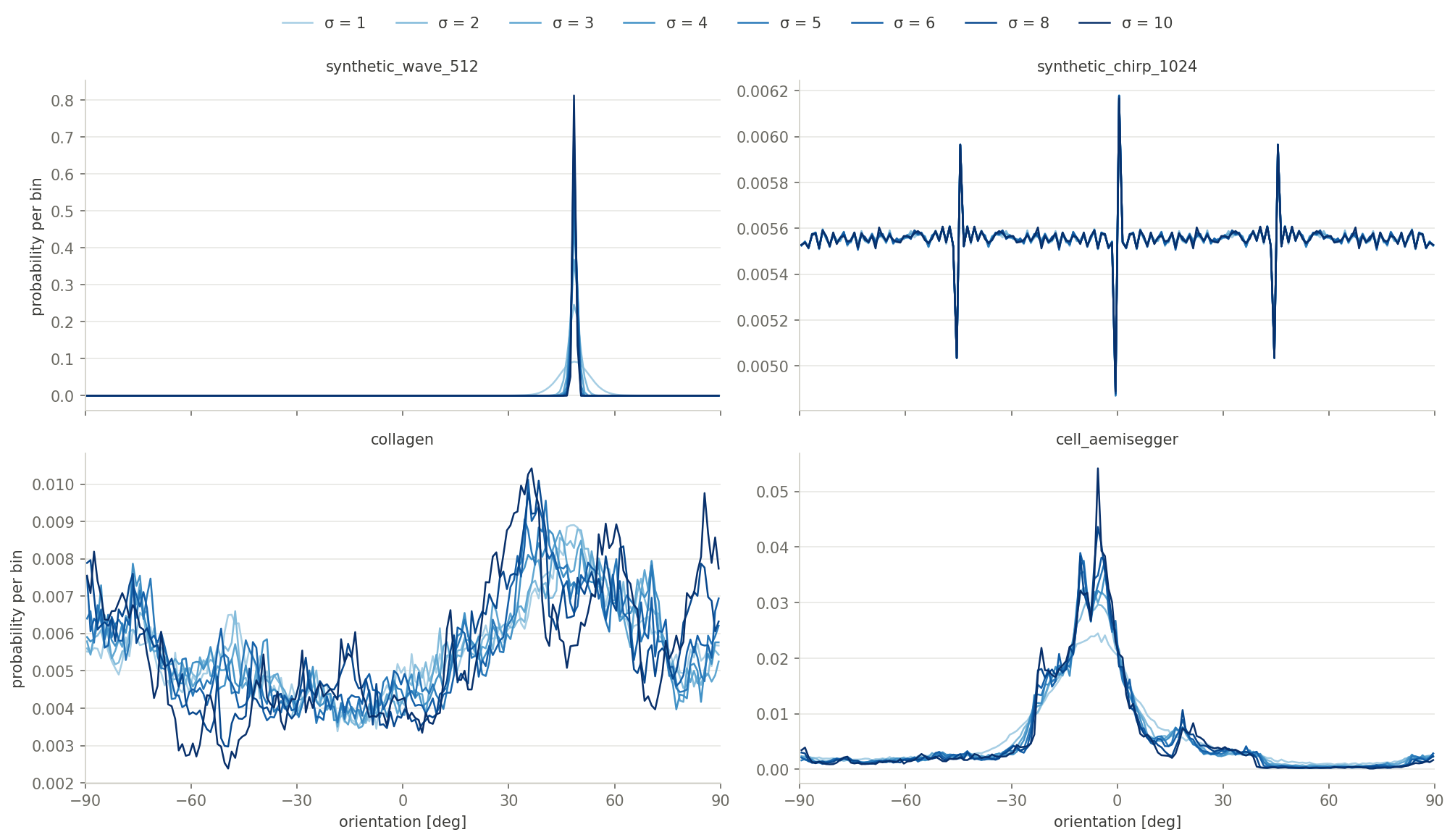
One panel per image, one curve per σ, from light blue (σ = 1) to dark blue (σ = 10); 180 bins of 1° over [−90°, 90°], normalized to probability per bin, pixels inside the structure mask only. On the wave, every σ gives a single peak at 45°, the orientation of the 8 px wave, which narrows as σ grows. On the chirp, the distribution is flat at 1/180, with three spikes at −45°, 0° and 45°. On collagen, the broad maximum lies between 30° and 60° at every σ. On the cell, the peak near −5° sharpens from σ = 1 to σ = 10.
Color survey versus σ
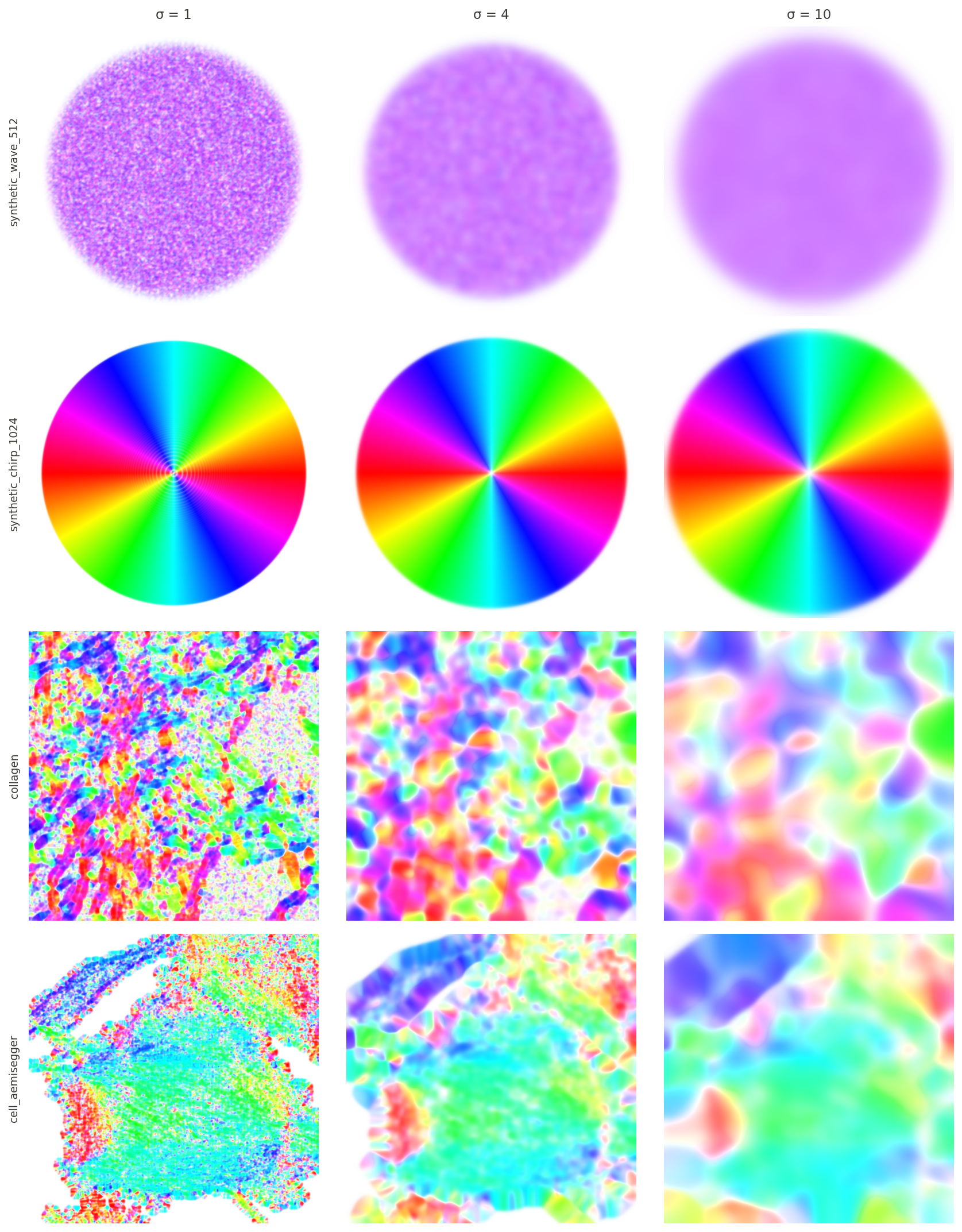
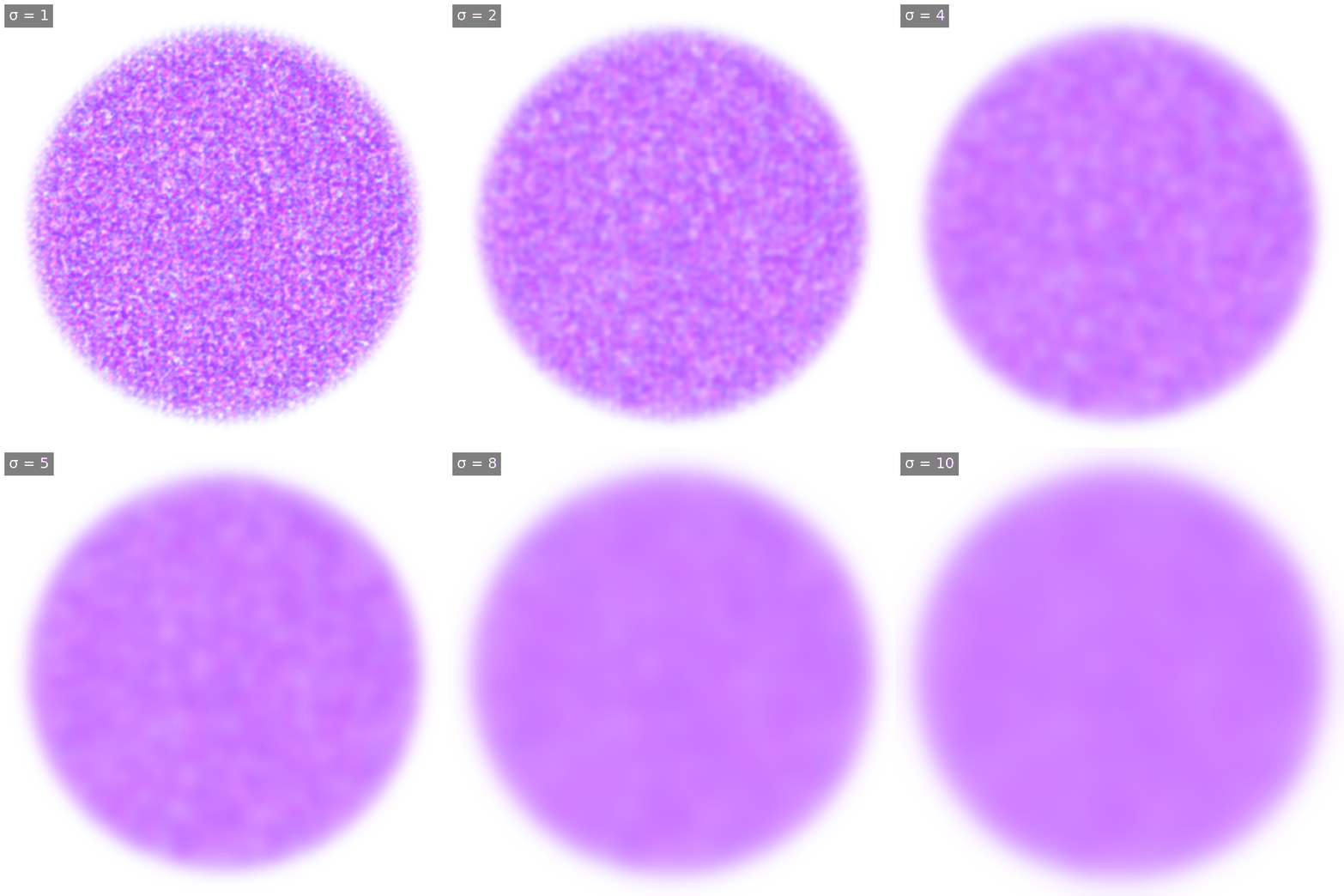
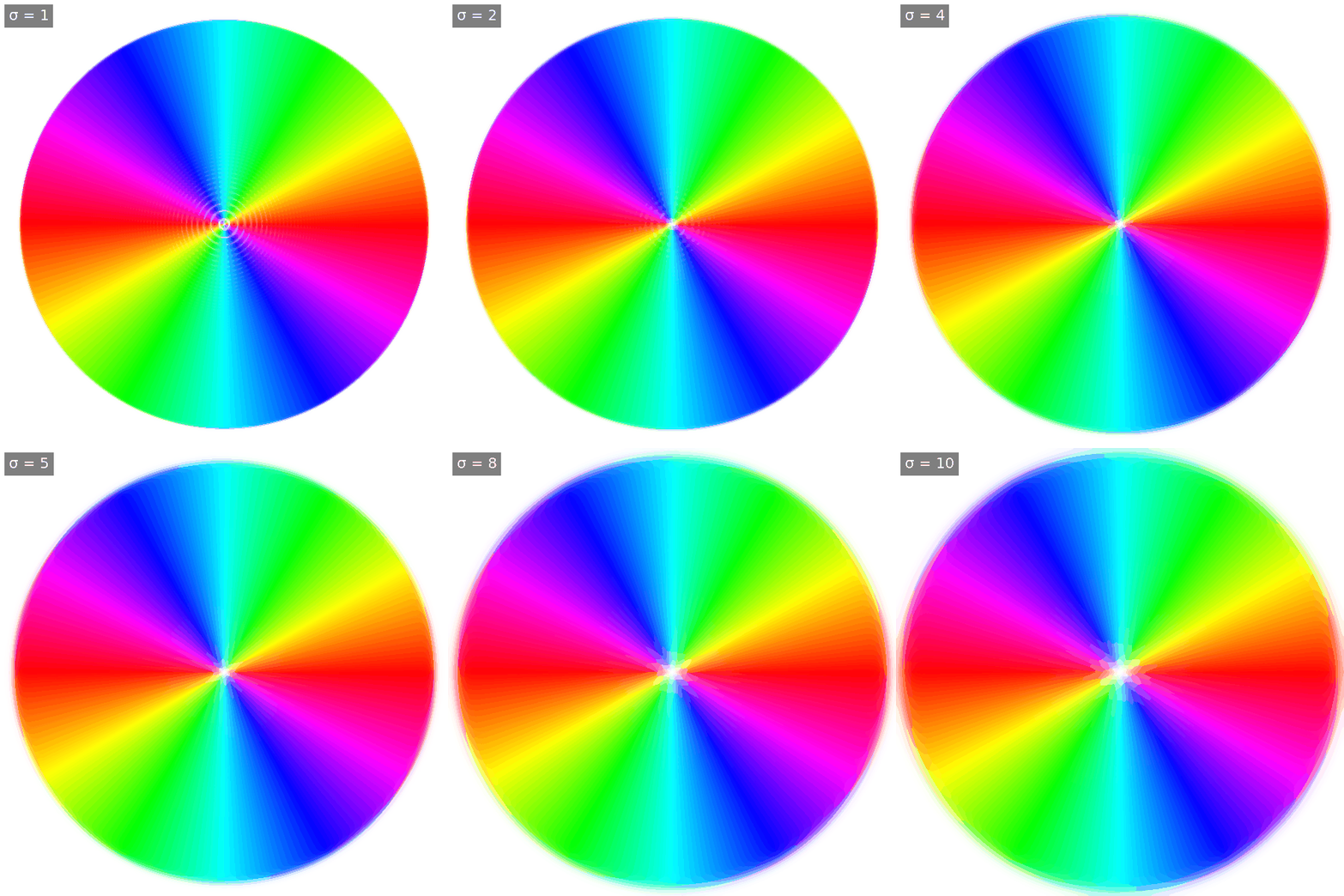
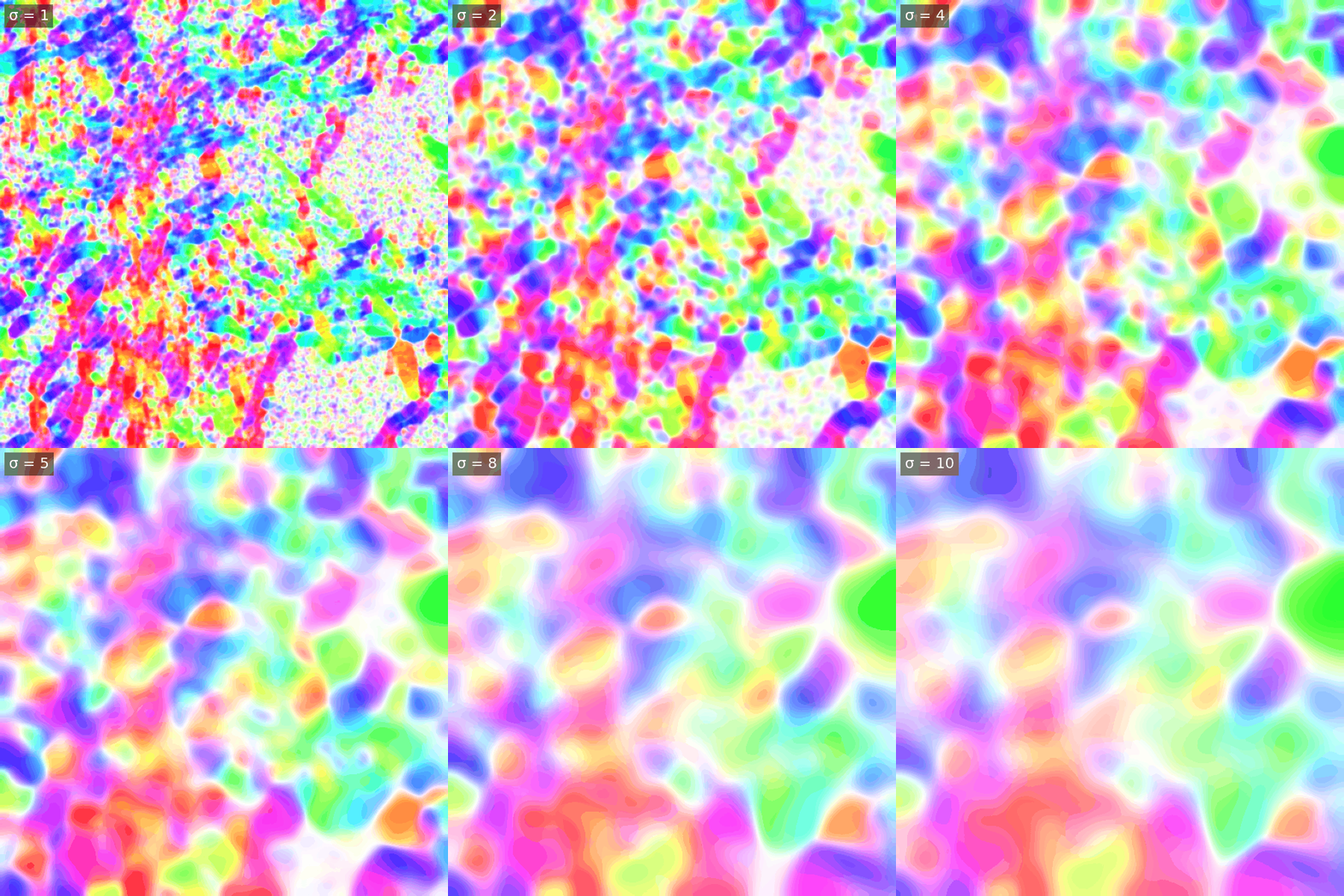
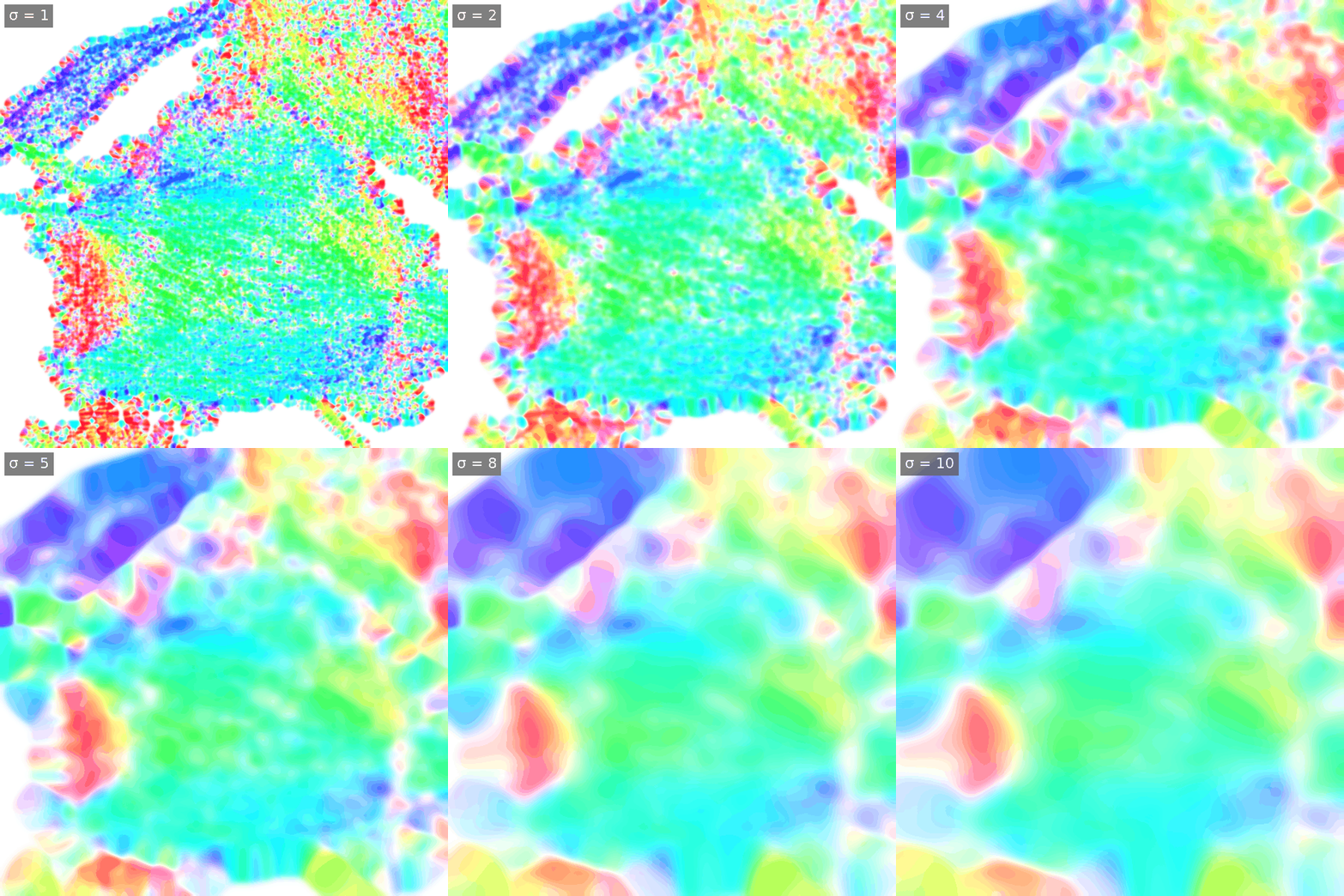
The color survey of the plugin at σ = 1, 4 and 10: hue = orientation, saturation = coherency, brightness constant (the default of the macro, which has no bri key). Below, the same survey animated over the eight σ, 0.7 s per frame.
Vector field versus grid size
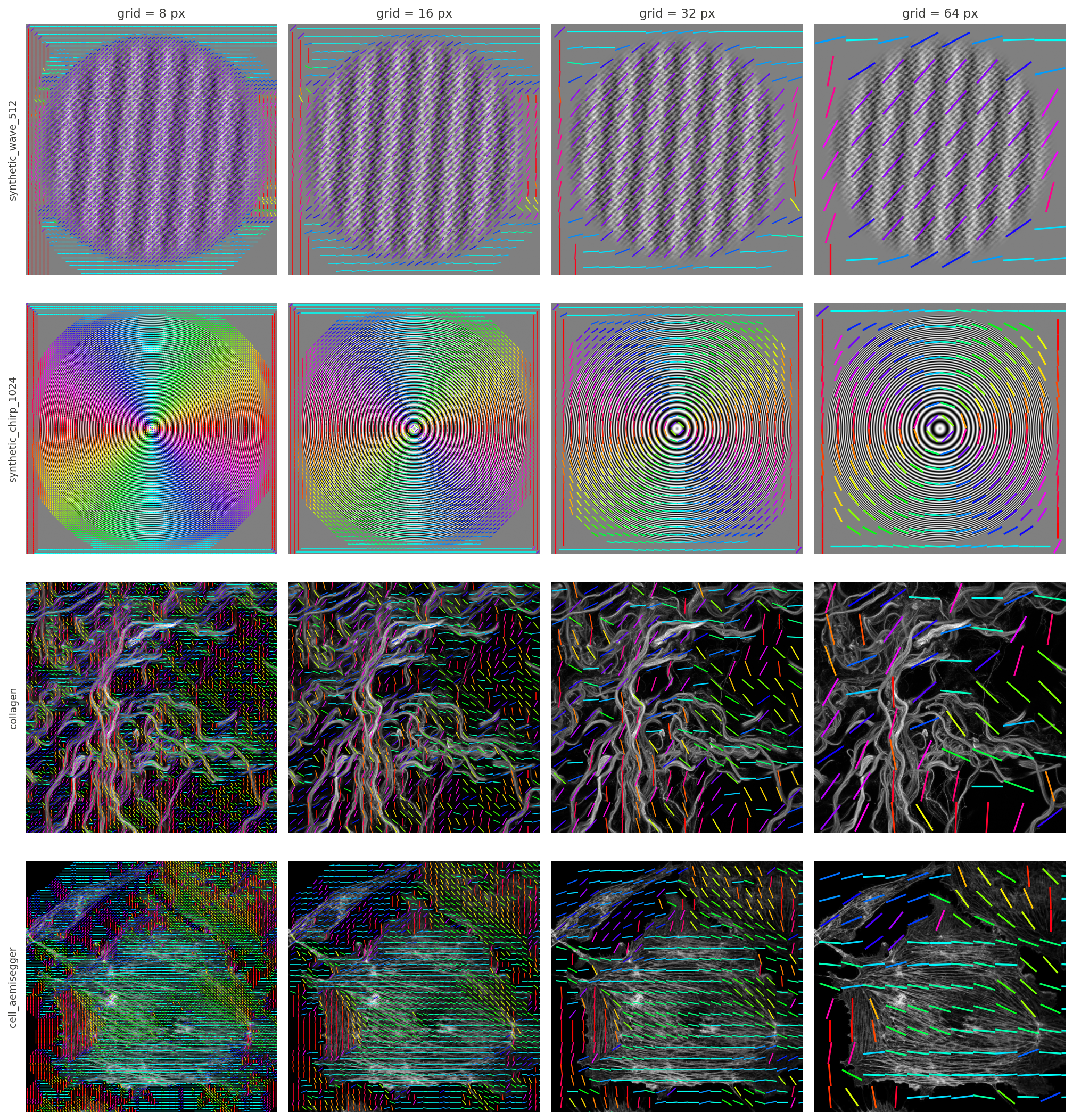
The vector field at grid sizes 8, 16, 32 and 64 px (σ = 1, nematic aggregation): one segment per cell, as long as the cell, drawn from the table and colored by its orientation with the hue wheel of the survey. Below, the field animated over the seven grid sizes 8, 12, 16, 24, 32, 48 and 64 px, 0.8 s per frame.