
Benchmarking
Compares the distribution of orientation measured by six tools, all with the cubic-spline gradient and the structure-tensor window σ = 1 wherever the tool exposes those choices, on four images of the test set. Two comparisons:
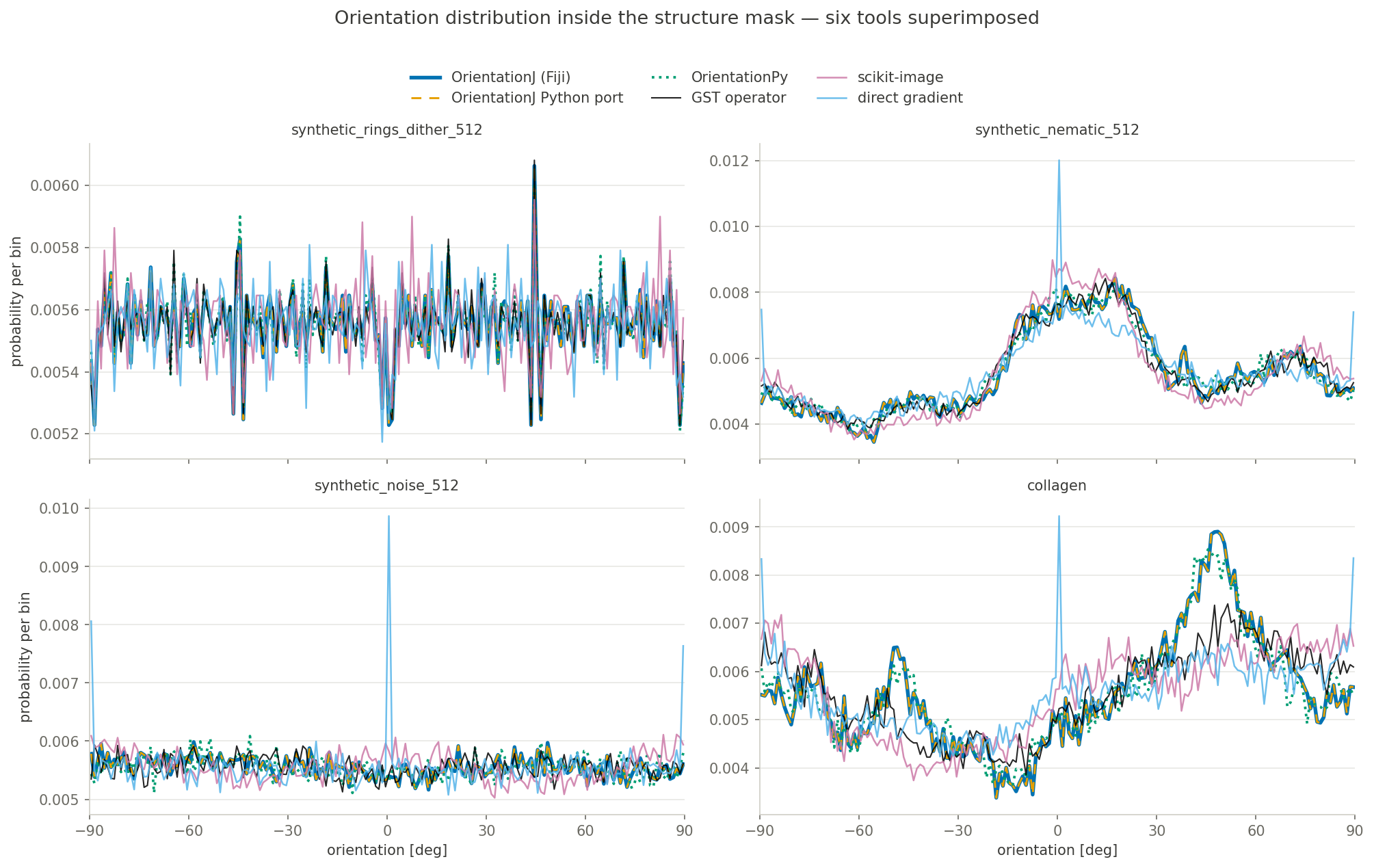
- masked — only pixels inside the structure masks; without Directionality (no mask support);
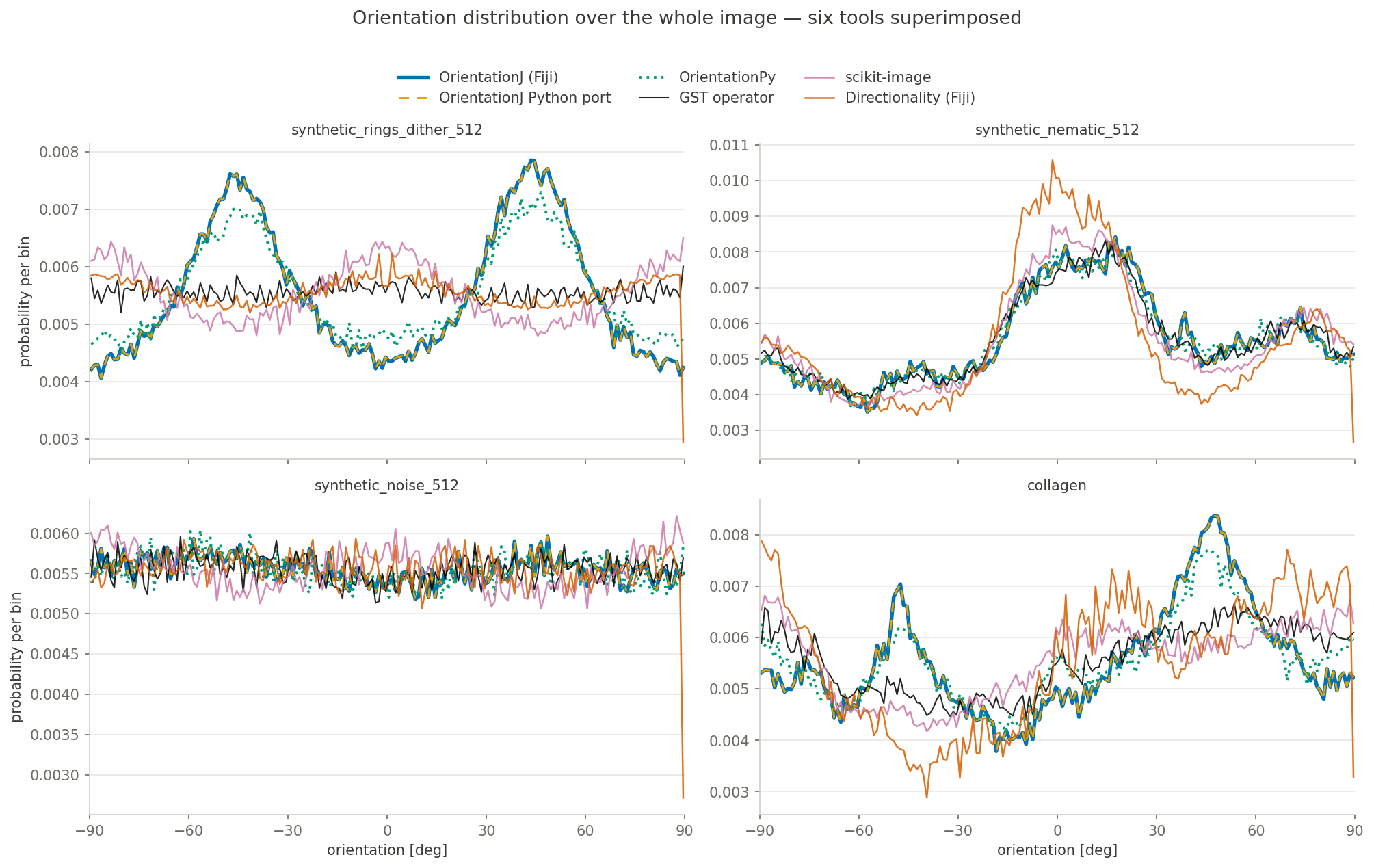
- full — every pixel of the image, without the direct gradient, whose unsmoothed histogram is dominated by the flat background.
Results
Inside the structure mask
Over the whole image
The six tools
- OrientationJ (Fiji) — the Java plugin; its saved orientation maps are binned here.
- OrientationPy — the Python successor, 2D and 3D; spline gradient, σ = 1, fiber orientation.
- GST operator — gst_operator.py, the
features()of the minimal Python version: Gaussian-derivative gradient and Gaussian window, separable convolutions in space. - scikit-image —
feature.structure_tensor(finite-difference gradient), same tensor formula. - direct gradient — the plugin run with σ = 0: the per-pixel angle perpendicular to the spline gradient, no tensor smoothing.
- Directionality (Fiji) — local-gradient method, its own histogram; no mask support, whole image.
All tools share the OrientationJ angle convention (verified on calibration sinusoids): degrees in [−90, +90], counter-clockwise from the horizontal of the displayed image. Histograms: 180 bins of 1°, normalized to probability per bin.