Color Survey HSB
The color survey is the output OrientationJ is recognized by: one image in which the direction of every structure is readable at a glance, without looking at three maps at once. It is built in the HSB color space, and it uses the hue for the orientation because the two are both circular: an angle is defined modulo 180°, and hue returns to itself after a full turn of the color wheel. Mapping one onto the other therefore leaves no seam — the color changes continuously as the structure turns, and no false boundary appears where the numbers merely wrapped around. A gray scale from −90° to +90° would put a black-to-white cliff exactly where nothing happens.
Each channel carries one feature. Hue takes the orientation, over half the wheel so that the whole range of angles is covered once: green at 0°, blue at +45°, red at ±90°, orange at −45°. Saturation takes the coherency by default, so that a well-defined direction comes out vivid while an isotropic neighborhood stays gray, whatever angle was measured there. Brightness takes the original image, or the energy — scaled or raw — so that the structures remain recognizable and the empty background stays dark.
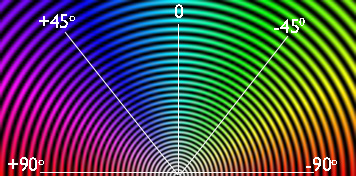
The color coding of the orientation: green at 0°, blue at +45°, orange at −45°, red at ±90°. Any feature can be assigned to any channel in the dialog; this is the default.
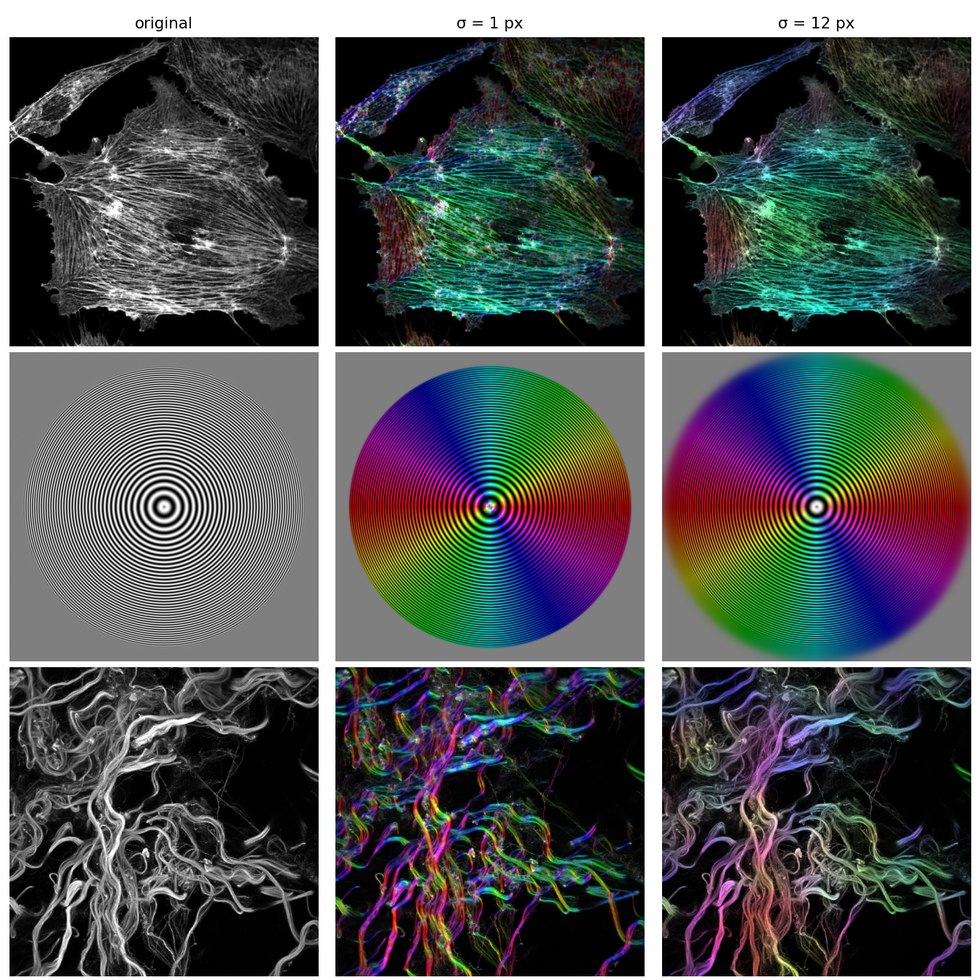
Three images, each analyzed at a small and at a large scale. The hue follows the local direction in both; the small window resolves every fiber, the larger one keeps only the trend that survives at its size.