
Selecting the gradient
The gradient decides how the derivatives are estimated before the tensor is assembled — the second setting of the Structure Tensor block, and the one to leave alone unless you have a reason not to.
The gradient decides how the derivatives are estimated before the tensor is assembled. Keep Cubic Spline, the default, unless you have a reason not to: it is the exact derivative of the cubic-spline interpolation of the image and stays accurate down to fine structures.
Of the others, Finite Difference is the fastest but one to two orders of magnitude more biased, increasingly so as structures get finer; Fourier, Riesz and Gaussian are band-limited derivatives that hold their accuracy at small periods, at the cost of spatial locality — Fourier can ring near the borders.
The measured angular error of all five, against analytic ground truth, is in the gradient and in the gradient assessment.
The five gradients
The gradient decides how the derivatives are estimated before the tensor is assembled. On a chirp, whose local period is known everywhere, the differences are measurable:
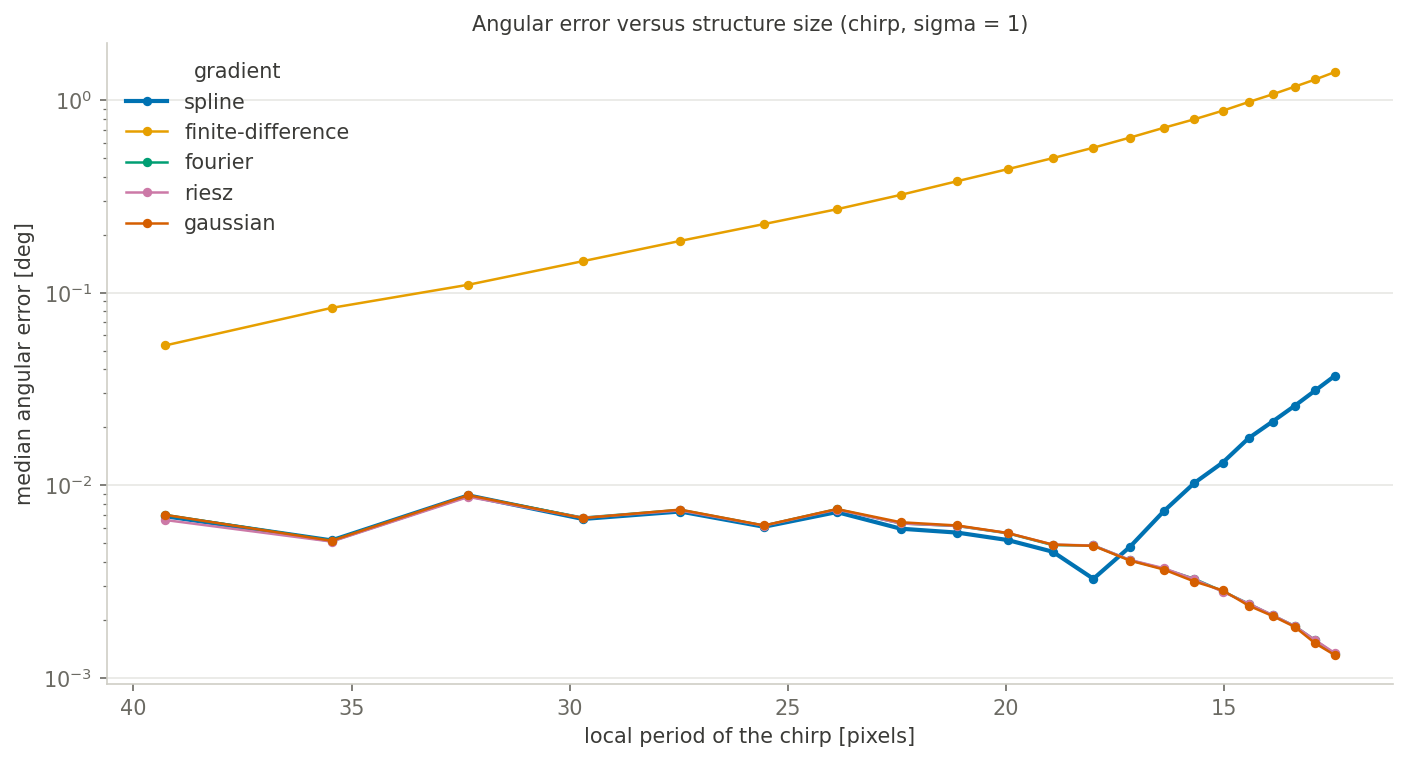
- Cubic Spline (the default) — the exact derivative of the cubic-spline interpolation of the image: accurate down to fine structures, and the setting used throughout this documentation. Keep it unless you have a reason not to.
- Finite Difference — the simplest and fastest, but one to two orders of magnitude more biased, increasingly so as structures get finer.
- Fourier, Riesz and Gaussian — band-limited derivatives that stay accurate at small periods, useful on noisy or oscillating data, at the cost of spatial locality (Fourier can ring near the borders).
The five gradients of the plugin are compared quantitatively, against analytic ground truth, in the gradient assessment, and the Gaussian derivative is the one used by the minimal operator.