
Python port
A faithful NumPy port of the OrientationJ gradient structure tensor (GST) and three notebooks that run it on the 16 test images.
Contents
| file | content |
|---|---|
| orientationj.py | the port: spline gradient, IIR Gaussian, tensor features, color survey, distribution, vector field |
| analysis.ipynb | OrientationJ Analysis → orientation / coherency / energy TIFFs + color survey PNG per image |
| distribution.ipynb | OrientationJ Distribution → 180-bin histogram CSV per image + statistics |
| vector_field.ipynb | OrientationJ Vector Field → vector table CSV per image + overlays |
| make_gallery.py | generates the overview panels of the test images |
Experiments
The resulting panels are published in the test-images results.
Masks
The distribution and the vector field are computed inside the masks of ../test-images/masks (nonzero = analyzed). This removes the flat background, whose degenerate structure tensor (exactly Jxy = 0 or Jxx = Jyy in float32) otherwise piles up in the 0°, ±45° and ±90° bins.
Settings
All experiments use the cubic-spline gradient only (the plugin default, gradient code 0), σ = 1 for the Gaussian window of the structure tensor, a 16 × 16 vector-field grid, and the plugin defaults everywhere else (ε = 0.001, min-coherency = 0 %, min-energy = 0 %, vector scale 100 %).
What the notebooks produce
Three notebooks drive the port, one per family of output — the same three examples as the macros of the plugin, computed here in Python.
The color survey of an image
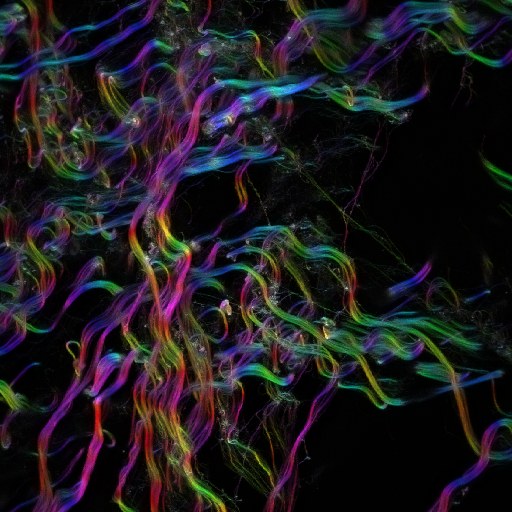
analysis.ipynb — collagen, σ = 2
A vector field over the structures
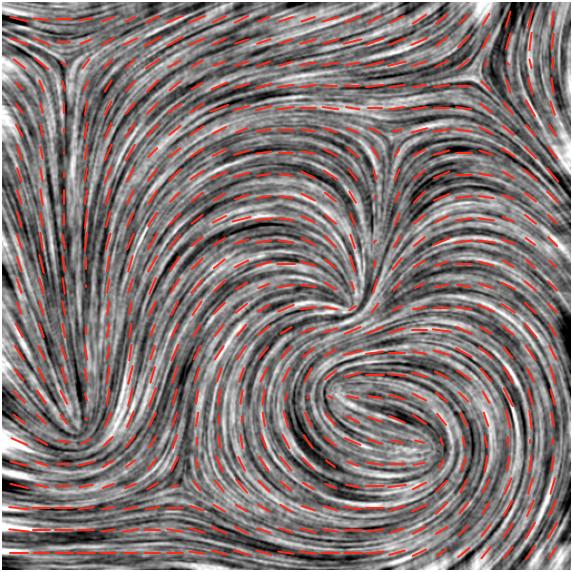
vector_field.ipynb — nematic, σ = 4, grid 20, length by coherency
An orientation distribution, background excluded
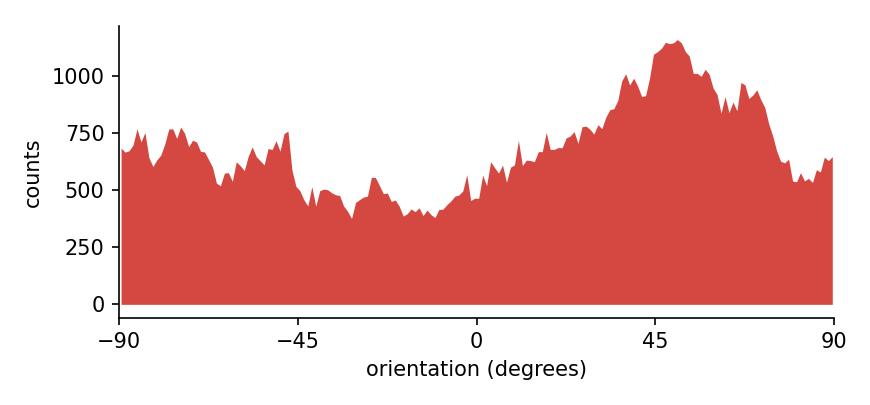
distribution.ipynb — collagen, σ = 2, coherency ≥ 30 %, energy ≥ 10 %